Roy Lichtenstein (1923–1997) is one of the two or three artists — alongside Andy Warhol — who defined American Pop Art and changed permanently what painting was allowed to do. Born in New York and trained at Ohio State University, he made his decisive move in 1961 when he began painting enlarged comic strip panels in oil on canvas, projecting the source material and then refining the composition by hand — including the meticulous hand-painted imitation of Ben-Day dots, the mechanical printing process of cheap comics reproduced at monumental scale with the care of a Renaissance fresco.
The argument was precise and radical: that the visual language of the comic strip, the advertisement, and the newspaper was as legitimate a subject for serious painting as the landscape, the portrait, or the nude. That mass culture was culture. That the boundary between high and low was a fiction maintained by institutions with an interest in maintaining it.
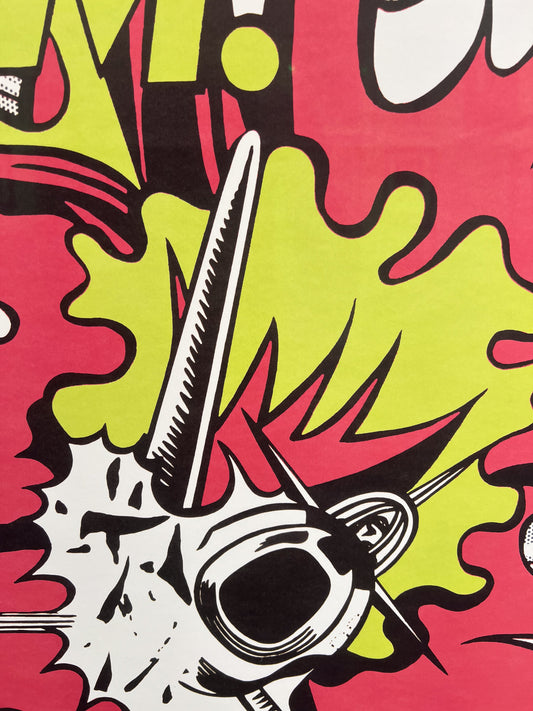
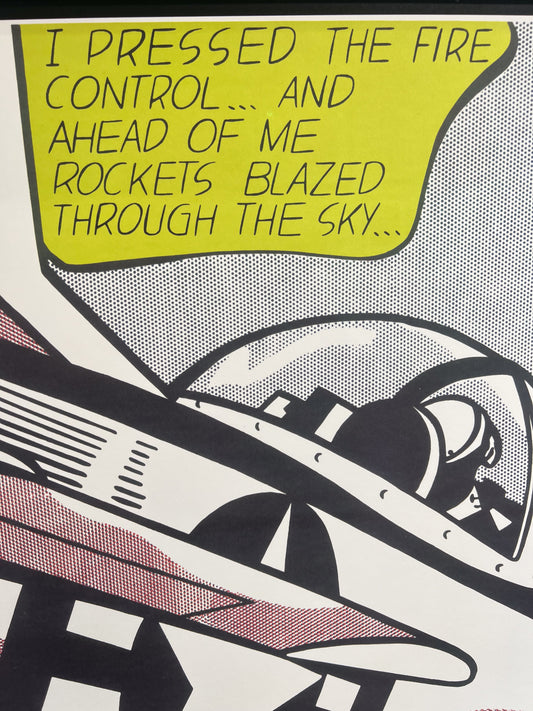
Whaam! — painted in 1963 and acquired by the Tate Gallery in 1966, where it has hung ever since — is among the most celebrated works in the history of Pop Art. The image of the exploding jet, the onomatopoeic WHAAM! arcing above the fireball, the moment of violent impact rendered in the bold primaries and heavy black outlines of the comic book: Lichtenstein understood that the comic book artist had already solved the formal problem, and his contribution was to recognise that solution as art.
His work is held in the permanent collections of the Museum of Modern Art, the Tate Modern, and the Guggenheim. The Tate Gallery editions available through Creed Gallery are the authorised publications produced by the institution that has held the original since 1966. Available through Creed Gallery, Ascot, for collectors across Berkshire, Surrey, Sunningdale, Virginia Water, and London.