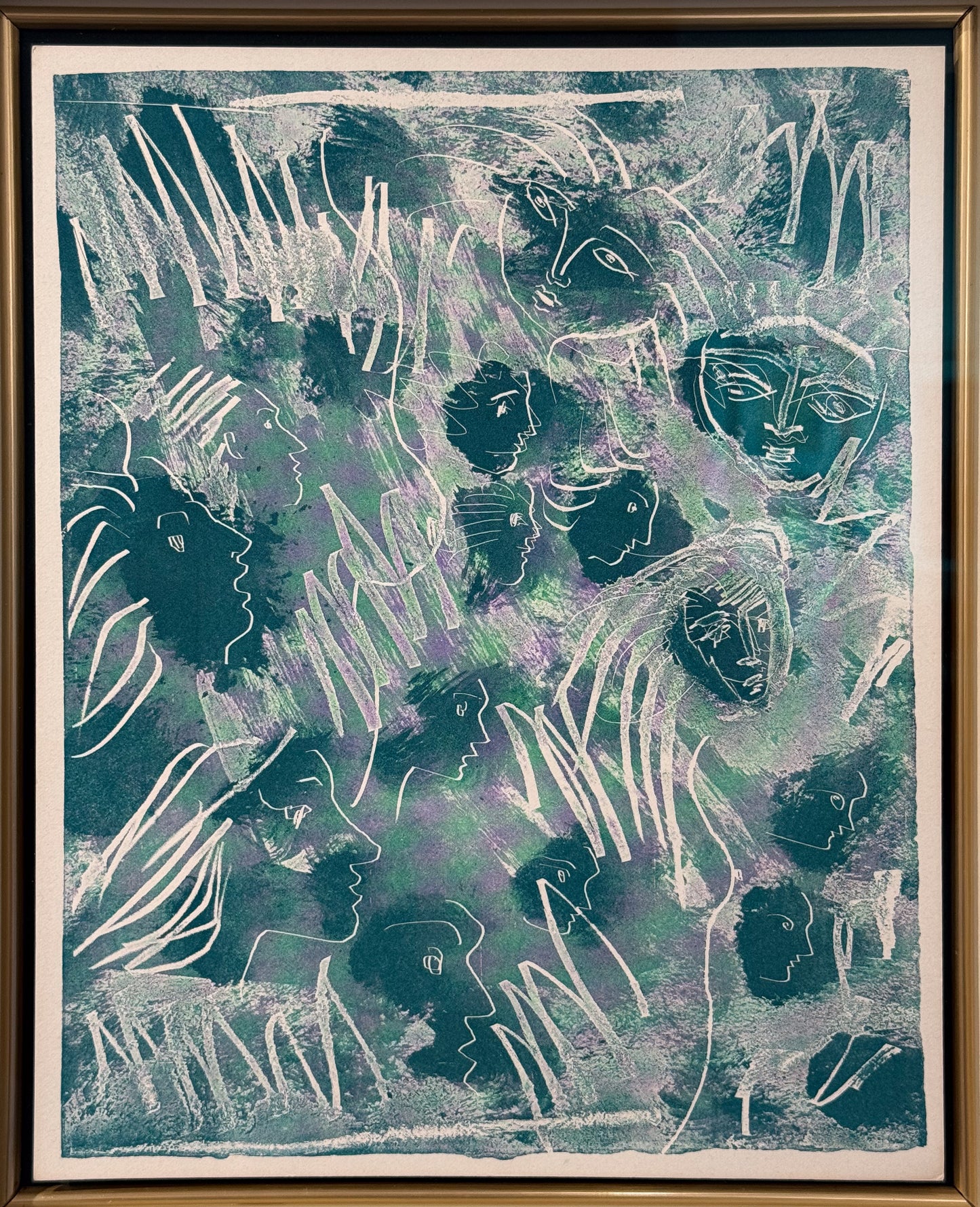
Pablo Picasso | Variant of Faces (from La Chèvre-Feuille)
Pablo Picasso | Variant of Faces (from La Chèvre-Feuille)
Couldn't load pickup availability
Pablo Picasso (1881–1973) — Variant of Faces (Blue) fromLa Chèvre-Feuille Suite, 1943
This Variant of Faces is drawn from La Chèvre-Feuille, a 1943 book written by French poet and Surrealist Georges Hugnet, illustrated with six Picasso zincographs and published in Paris by Robert-J. Godet — with an accompanying insert essay by Paul Éluard. Produced in Paris during the German Occupation, Picasso's transformed, interpenetrating figures follow dream logic rather than anatomical convention, resulting in images that are simultaneously portraits and formal experiments.
Created during the German Occupation of France, the work belongs to an important period in Picasso's career and reflects the experimental approach to form and figure that characterised much of his work during the 1930s and 1940s.
About the Zincograph Process
Zincography is a printmaking process in which an image is drawn or transferred onto a zinc plate, which is then treated to create the printing surface.
The technique is closely related to lithography and allows an artist to reproduce fine lines, tonal variation and expressive marks with considerable detail. Picasso used zincography for a number of illustrated publications and editions, particularly during the 1940s.
Zincographs are valued for their direct connection to the artist's original printmaking process. Rather than being a later photographic reproduction, the image is produced from a printing plate created specifically for the edition.
The process allowed Picasso to retain the immediacy and character of his line while producing works in an editioned format, making zincography an important part of his graphic work.
Artist: Pablo Picasso (1881–1973)
Date: 1943
Medium: Zincograph on Lafuma wove paper
Edition Size: 500, unsigned
Framed Dimenions: 41 x 47 cm
Subject: La Chèvre-Feuille Suite
Publisher: Robert J. Godet, Paris
Share